Sunday, February 26, 2012

Polemic: Industrial Tourism and the National Parks


Page 385.  The general point made by Edward Abbey in his work Polemic: Industrial Tourism and the National Parks is that we need to take better care of the national parks to preserve their beauty.  More specifically, Abbey argues that the tourists that visit the parks need to be more aware of how they are affecting the park depending on what they are doing or how they are camping.  He writes, “campgrounds where I used to putter around reading three-day-old newspapers full of lies and watermelon seeds have now been consolidated into one master campground that looks, during the busy season, like a suburban village” (p. 387).  In this passage, Abbey is suggesting that most of the modern-day tourists are ruining the national parks with all their motor vehicles and their way of camping when they come to visit the national parks.  In conclusions, it is Abbey’s belief that if we don’t ban motor vehicles and paved roads from national parks, they will be destroyed and future generations will not be able to enjoy them.
            In my view, Abbey is right because many of the modern-day tourists only do things in ways in which they are comfortable.  For example, I have been camping many times in my life, but only once have I ever camped in a tent, without flushable toilets and no electricity whatsoever.  People only do what they feel comfortable with.  Although Abbey might object that his idea might drive some people away from camping, I maintain that it would, but only the people that were really against going without all of their high-tech gadgets.  Therefore, I conclude that we do need to take better care of our national parks in whatever way possible so that our posterity will be able to enjoy them.

Sunday, February 19, 2012

Wildlife in American Culture


Page 372.  The general point made by Aldo Leopold in his work Wildlife in American Culture is that modern society with all its new technology and inventions, is having a very negative impact on the environment.  More specifically, Leopold suggests that society is continually destroying parts of the environment when we really don’t need to.  He writes, “the conquest of nature by machine has led to much unnecessary destruction of resources” (p. 372).  In this passage, Leopold is suggesting that society as a whole can do a much better job with being aware of what we truly need to take from the environment and what we need to preserve.  In conclusion, it is Leopold’s belief that “we shall achieve conservation when…the destructive use of land becomes unethical” (p. 372).
            In my view, Leopold is right because we really could be better about preserving our natural resources to help save the environment a little bit more.  For example, we use a lot of paper and water as a society.  If everyone were to recycle every possible thing they could and to try to take shorter showers, turn off the water while brushing their teeth, and other things like that, it would help the environment so much.  Riding your bike would also help a lot to reduce pollution of the air we breathe every day.  Although Leopold might object that people don’t care about the environment because of the current world we live in, I maintain that everyone wants to help protect the earth we live on but they just aren’t sure how to do that.  Therefore, I conclude that if there was more awareness put out there about the environment and how our actions effect it, people would be better about doing things to help the environment rather than cause more damage that what has already been done.

Introduction & Peach Blossom


Introduction
(Page 341).  This passage was about how influential man and civilization in general can be on nature.  This really made me start thinking about how although people are separate from nature, we are a part of it just as much.  We influence nature so much, and we need to start taking better care of it.  This made me think of one of my favorite quotes, “We did not inherit the earth from our parents, but we are borrowing it from our children.”  I really like this quote because it makes me want to take better care of the earth for my children.  In this passage, the quote “their cultures maintained a sense of nature as intimately connected with who we are” (p 342) really made me think of how if our society was more connected to nature and had it as a sense of how we became who we are today, we would want to take better care of our earth.

Peach Blossom
(Page 344).  This poem depicts a fisherman travelling down a stream where he finds a cave.  He goes into the cave and discovers a small village of people who live simple and ordinary lives, but are very happy.  They had “lost all connection with the outside world” (p. 344).  I think that the moral of the story here, is that everyone can be happy if they go looking for it.  Being happy is achieved by simplifying your life, in whatever way you see possible.  People in today’s society need to recognize this and not stress over the little things in life.  American culture is probably one of the biggest cultures that need to simplify.  A lot of other cultures in the East, like places of Africa and India, lead very simple lives.  They are much happier there because they are more aware of themselves and the world around them.  They feel connected to everything and are happier because of it.

Friday, February 10, 2012

Reading Quiz #2


Reading literature can help society better understand and connect to other cultures.  Mario Vargas Llosa writes, “we share as human beings, what remains common in all of us under the broad range of differences that separate us.  Nothing better protects human being against the stupidity of prejudice, racism, religious or political sectarianism…that men and women of all nations and places are essentially equal, and that only injustice sows among them discrimination, fear, and exploitation” (p. 40).  What he means by this is that every human being, no matter what race, religion, gender, or culture, is all equal and that one can only become connected to others of a different race, religion, etc. is by reading literature.  That is the only possibly way one can become aware of the world around him.
            An example that comes to mind is the novel Uncle Tom’s Cabin by Harriet Beecher Stowe.  Through this piece of literature, people come to understand the importance of life, liberty, and equality among all people.  Uncle Tom’s Cabin truly showed what it was like to be a slave in the South in the 1850’s.  This novel played a huge part in the Civil War because it showed how awful it was for the slaves.  People realized that slavery was wrong and immoral and started fighting for what they believed in after they read this.  Literature can have such a strong influence on people to do incredible acts of valor that they never thought they had the strength to do.  This shows that through literature, people can become connected and aware of what is going on in the world around them, and standing up for what they believe in.
            On the other hand, Laura Bohannan thought that everyone viewed the world as well as stories the same way no matter what culture or religion.  However, she also proves the point that only through literature can society understand one another by finding out that she is wrong about how she thinks of other cultures once she tells a tribe in Africa the story of Hamlet by Shakespeare.  At the beginning of her story, she thinks “human nature is pretty much the same the whole world over” (p. 29).  She realizes she is wrong by the end of telling her story because the African tribe was so confused on so many different parts of the story.  They didn’t view the story the same way she did, like thinking that two years was much too long for a widow to mourn, or that it is very acceptable for the brother to marry the deceased brother’s wife.  She realizes at the end that only through reading literature and thinking about how other cultures might view the world, stories, or poetry differently, that that is the only way the whole world can be connected.  Through education of other cultures, religions, etc. and by reading can society understand one another even through their differences.
            An example that proves the point that only through reading can people become connected is the example of how differently the story of Cinderella is viewed differently in the United States rather than in China.  In Cinderella in the United States, the Fairy Godmother is an actual person who grants wishes to Cinderella.  However, in China, the Fairy Godmother is a coy fish who grants wishes to Cinderella.  In China, the coy fish is a symbol of good luck.  If society didn’t have literature, no one would be able to understand how cultures would view the exact same story so differently.  Because society has literature though, everyone feels connected because each culture is trying to understand the beliefs, ideas, and opinions of another culture in which they are reading about.
            These two articles, Shakespeare in the Bush by Laura Bohannan and Why Literature? by Mario Vargas Llosa, are connected because only through reading literature can the whole world understand each other.  Without literature, nothing connects us to one another because everyone is so different and unique.  Each culture, religion, political group, etc. will always have different opinions and views on everything under the sun.  However, if everyone makes an effort to learn from literature and understand the other person’s point of view, society will feel more connected as a whole.
Through literature, people won’t feel as alone as they did before reading.  They will feel they have a better understanding of another person’s culture because of the literature they have read on that specific subject of that culture’s beliefs.  Through understanding other’s culture, people become more aware of themselves and better understand themselves because they have learned something new about someone else.  Therefore, reading literature can help society better understand and connect to cultures around the world, including their own.

Sunday, February 5, 2012

Education by Poetry


Page 48.  The general point made by Robert Frost in his work Education by Poetry is that you can become close to poetry in only two different ways.  More specifically, Frost suggests that these ways are reading poetry or writing poetry, but only if you have such a desire to do so.  He writes, “ the person who gets close enough to poetry, he is going to know more about the word belief than anybody else knows, even in religion nowadays…every time a poem is written…it is written not by cunning, but by belief” (page 50).  In this passage, Frost is suggesting that only by experiencing poetry, whether it be through reading or writing, but by experiencing it is the only way we can come to know and understand poetry.  In conclusion, it is Frost’s belief that poetry can only be experienced and truly understood by reading or writing it.
            In my view, Frost is right because you can never really understand something, whether it be an experience or a piece of text/poetry, unless you really go through the process of trying to understand it, by reading about it or writing about it then truly thinking about what you have just learned.  For example, you can’t really fully understand someone who went through The Great Depression unless you either listen to them (reading) or you talk to them about what they went through (writing).  Although Frost might object that everyone can understand poetry, I maintain that everyone can if they really think about and try to have their own interpretation and opinion of it.  Have ideas about the text of what they are reading.  Therefore, I conclude that poetry can be understood by anyone if they just learn to have their own opinions and beliefs about what they are reading or writing.

Why Literature?


Page 39.  The general point made by Mario Vargas Llosa in his work Why Literature? is that society is becoming less and less free and more “soulless” because of how little people are reading in the world today.  More specifically, Llosa argues that through literature, people feel more connected to one another and to the earth through their experiences and connection with the reading.  He writes, “we share as human beings, what remains common in all of us under the broad range of differences that separate us.  Nothing better protects human being against the stupidity of prejudice, racism, religious or political sectarianism…that men and women of all nations and places are essentially equal, and that only injustice sows among them discrimination, fear, and exploitation” (page 40).  In this passage, Llosa is suggesting that people are all connected and equal through literature; that is how we understand one another and our feelings.  In conclusion, it is Llosa’s belief that if we do not continue to read and promote literature in our everyday lives and the lives of others, we as a society, will become desensitized to everything around us.
            In my view, Llosa is right because if literature did not exist, America wouldn’t be here today.  No one would have any type of a connection with other people and try and understand what someone else is going through without actually going through it themselves.  For example, our government wouldn’t be as it is now, and women and minority races would still be considered “unequal” to white men.  Although Llosa might object that technology has helped society, I maintain that it really has helped society but we must be careful with the way in which we use it.  Therefore, I conclude that we need to be more aware of the way in which we view literature within the world and how it influences us.

Friday, February 3, 2012

Week 3 Reflection

How does the author's culture bias affect her argument?

In Shakespeare in the Bush, the author's culture bias affects her argument in the way that she cannot successfully convey the meaning of her story to the African people.  She just assumes they know everything and that they will see everything the same way she sees it.  However, because of the different cultures, the African people see it very differently than the author, so she cannot fully convey the meaning of the story to them because they do not see the story the same way she does.

Breughel's Icarus:


1.      Subject: The Old Masters
2.      Found: Second line of poem
3.      Order: Incorrect
4.      Trying to say: The Old Masters were never wrong about suffering.
5.      Auden’s argument: “The Old Masters were never wrong about suffering.”
6.      How he makes the argument: He begins very general and he moves more and more specific until he is pointing to very specific examples within the painting.
7.      Does he provide evidence: Yes, The Old Masters knew how to paint pain and suffering, meaning they “understood it’s human position.”
8.      Title meaning: Museum of the Beautiful Arts
9.      Who are the “Old Masters”: Davincci, Michael Angelo, etc.
10.  Why is it capitalized: Because  it is a specific group of people.
11.  How you can find out more: by doing research and going to art museums to dig deeper on those artists and their paintings.
12.  How Auden moves through his argument: He goes from very general to very specific and ends up using the painting in his poem and using it as a detailed example.
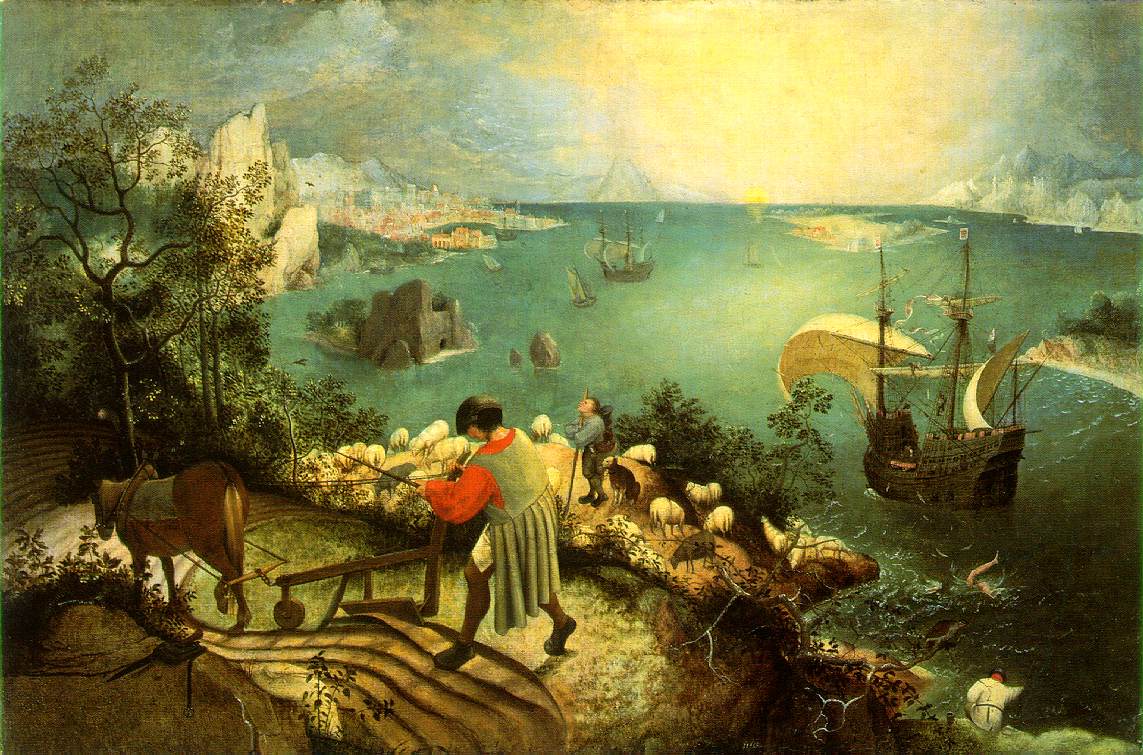
13.  Breughel’s Icarus: a painting that depicts how the world still goes on even through the suffering of others.
14.  Thesis: I agree with some parts of the thesis and disagree with it in other aspects.  I agree because a lot of the time, people around the world simply turn their heads or try and stay “blissfully ignorant” about other suffering.  For instance, all Americans know there is a war going on in Iraq, but little actually know the full impact it is having on the troops and their families.  Many don’t know just how bad it is and what our soldiers are going through, simply because it is easier to turn our heads and act like everything is fine.  On the other hand, I disagree with his thesis because there have been many times in the world where some type of natural disaster has occurred and America and various other countries with the proper resources have come to help the country that has been affected by whatever disaster has occurred.  Therefore, I agree and disagree with his thesis because people can be very willing to help others, but people can also be willing to stay ignorant of the suffering of the rest of the world.
15.  Auden could come from a different country and therefore would have many different experiences than the rest of us, thus causing his opinion to be the way it is.
16.  His living in Europe in the 1930’s definitely affected his views about human suffering and how people responded to it.  This was during WWII and many people in Europe turned their heads to what was going on with the Jews.  He noticed that no one, except for very few, that would actually help those in need at the time.
17.  I think Auden feels like The Old Masters knew how to display their pain and suffering in the world around them through their paintings.
18.  The Old Masters were looked very highly upon by not only Auden, but other writers, painters, and various artists as well.
19.  The Old Masters were looked very highly upon because people can relate to them through their suffering and The Old Masters paintings.
20.  Auden is affected by being in a museum because he feels more inspired there by being around all those other paintings.
21.  Because the boy is drowning in the water and everyone is going on with their business like absolutely nothing is wrong.
22.  Yes, there are similarities that were going on in history that could make the Old Masters and Auden see things similarly.  Wars were going on at both these times, making the artists see things similarly.
23.  The wars were about very different things, and each artist might have had a different view point about the war specifically.
24.  Each painting has a distinct story that can be “read” by anyone, but everyone has very different interpretations of each painting.
25.  We’re expected to see a “museum of beautiful arts” from the title.
26.  We see a painting that depicts physical and emotional human suffering that can either be ignored or helped by others.
27.  The painting wants you to see happiness, sunshine, and contentedness.  What is hard to notice however, is the legs flailing in the water right by the ship.  The painting wants to make it hard for you to notice the suffering of the little boy drowning.
28.  Icarus is the boy drowning in the water by the ship.
29.  He is so small because the world tries to make it seem like one little person is so unnoticeable when it comes to suffering.  One person is nothing compared to the rest of the world.
30.  The people in the painting are ignoring him and going about their business and trying not to notice him.
31.  He said that people do not respond to human suffering. They ignore it, which is what is going on in the painting.
32.  Auden’s interpretation is a good one. It makes sense and there is evidence to back it up.
33.  Breughel’s historical and cultural context informed his art because off the myths and stories that were a big part of the culture at the time.
34.  I think Breughel’s interpretation of the story is correct.
35.  We would need to find the original source.
36.  The story makes it seem like everyone cared and was sad about the boy dying, rather than in the painting, Auden makes it seem like absolutely no one cares.
37.  Ovid’s point of view is so different because of the time period he came from.
38.  What was happening in the first century was that there were a lot of different emperors reigning over Rome.
39.  That might have affected his story telling because maybe every time Rome lost an emperor, the whole country was sad about it.  Maybe Ovid thought that whenever any one individual person died, everyone was sad about that one person.
40.  I think that the painting is more correct by the way of saying people are ignorant when it comes to the loss of the life of others.
41.  I feel sad and frustrated that so many people are blissfully ignorant of the lives of others, especially when they are fighting for our country, but even if they’re not, they are still a human being and every life is valuable.
42.  It confuses me and angers me why people act the way they do.  I know I act like that sometimes, but most people like it that way and don’t want to change and become aware of the lives of others around them.
43.  I would respond to Auden and tell him that he was correct in his assumptions then and still is today.
44.  I assume that both the writer and painter know what they are talking about and have specific reasons and evidence for believing the things they do and for having the opinions they have.