Sunday, February 5, 2012

Education by Poetry


Page 48.  The general point made by Robert Frost in his work Education by Poetry is that you can become close to poetry in only two different ways.  More specifically, Frost suggests that these ways are reading poetry or writing poetry, but only if you have such a desire to do so.  He writes, “ the person who gets close enough to poetry, he is going to know more about the word belief than anybody else knows, even in religion nowadays…every time a poem is written…it is written not by cunning, but by belief” (page 50).  In this passage, Frost is suggesting that only by experiencing poetry, whether it be through reading or writing, but by experiencing it is the only way we can come to know and understand poetry.  In conclusion, it is Frost’s belief that poetry can only be experienced and truly understood by reading or writing it.
            In my view, Frost is right because you can never really understand something, whether it be an experience or a piece of text/poetry, unless you really go through the process of trying to understand it, by reading about it or writing about it then truly thinking about what you have just learned.  For example, you can’t really fully understand someone who went through The Great Depression unless you either listen to them (reading) or you talk to them about what they went through (writing).  Although Frost might object that everyone can understand poetry, I maintain that everyone can if they really think about and try to have their own interpretation and opinion of it.  Have ideas about the text of what they are reading.  Therefore, I conclude that poetry can be understood by anyone if they just learn to have their own opinions and beliefs about what they are reading or writing.

Why Literature?


Page 39.  The general point made by Mario Vargas Llosa in his work Why Literature? is that society is becoming less and less free and more “soulless” because of how little people are reading in the world today.  More specifically, Llosa argues that through literature, people feel more connected to one another and to the earth through their experiences and connection with the reading.  He writes, “we share as human beings, what remains common in all of us under the broad range of differences that separate us.  Nothing better protects human being against the stupidity of prejudice, racism, religious or political sectarianism…that men and women of all nations and places are essentially equal, and that only injustice sows among them discrimination, fear, and exploitation” (page 40).  In this passage, Llosa is suggesting that people are all connected and equal through literature; that is how we understand one another and our feelings.  In conclusion, it is Llosa’s belief that if we do not continue to read and promote literature in our everyday lives and the lives of others, we as a society, will become desensitized to everything around us.
            In my view, Llosa is right because if literature did not exist, America wouldn’t be here today.  No one would have any type of a connection with other people and try and understand what someone else is going through without actually going through it themselves.  For example, our government wouldn’t be as it is now, and women and minority races would still be considered “unequal” to white men.  Although Llosa might object that technology has helped society, I maintain that it really has helped society but we must be careful with the way in which we use it.  Therefore, I conclude that we need to be more aware of the way in which we view literature within the world and how it influences us.

Friday, February 3, 2012

Week 3 Reflection

How does the author's culture bias affect her argument?

In Shakespeare in the Bush, the author's culture bias affects her argument in the way that she cannot successfully convey the meaning of her story to the African people.  She just assumes they know everything and that they will see everything the same way she sees it.  However, because of the different cultures, the African people see it very differently than the author, so she cannot fully convey the meaning of the story to them because they do not see the story the same way she does.

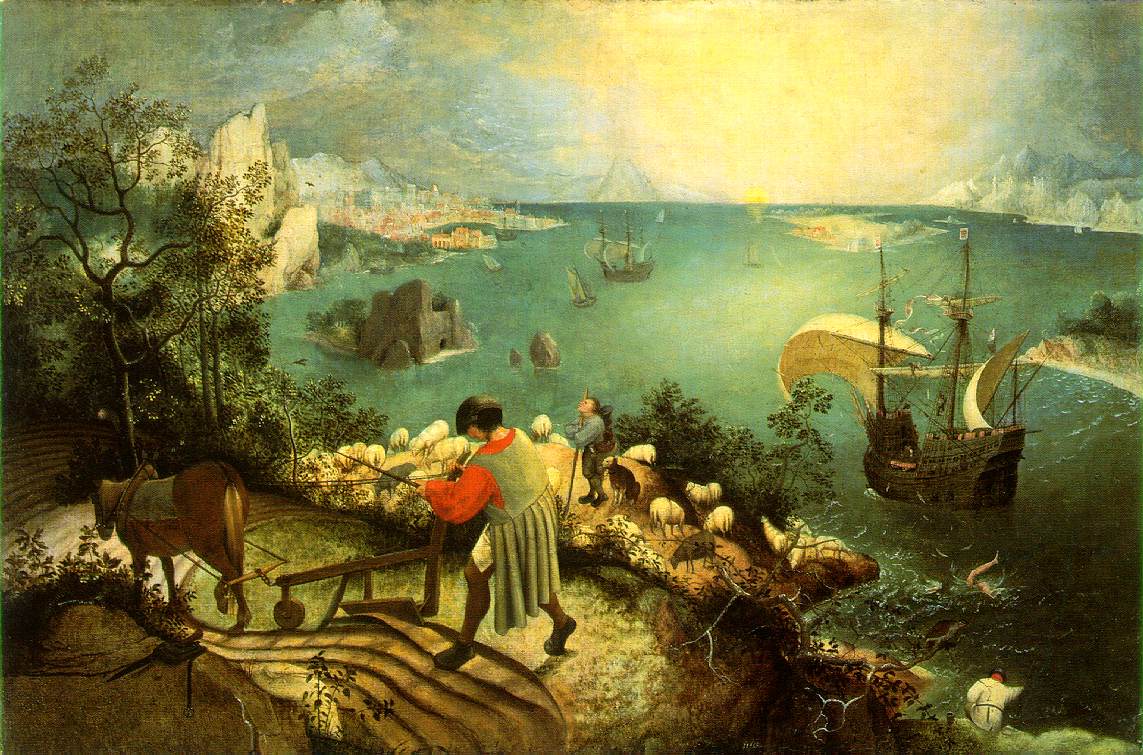
Breughel's Icarus:


1.      Subject: The Old Masters
2.      Found: Second line of poem
3.      Order: Incorrect
4.      Trying to say: The Old Masters were never wrong about suffering.
5.      Auden’s argument: “The Old Masters were never wrong about suffering.”
6.      How he makes the argument: He begins very general and he moves more and more specific until he is pointing to very specific examples within the painting.
7.      Does he provide evidence: Yes, The Old Masters knew how to paint pain and suffering, meaning they “understood it’s human position.”
8.      Title meaning: Museum of the Beautiful Arts
9.      Who are the “Old Masters”: Davincci, Michael Angelo, etc.
10.  Why is it capitalized: Because  it is a specific group of people.
11.  How you can find out more: by doing research and going to art museums to dig deeper on those artists and their paintings.
12.  How Auden moves through his argument: He goes from very general to very specific and ends up using the painting in his poem and using it as a detailed example.
13.  Breughel’s Icarus: a painting that depicts how the world still goes on even through the suffering of others.
14.  Thesis: I agree with some parts of the thesis and disagree with it in other aspects.  I agree because a lot of the time, people around the world simply turn their heads or try and stay “blissfully ignorant” about other suffering.  For instance, all Americans know there is a war going on in Iraq, but little actually know the full impact it is having on the troops and their families.  Many don’t know just how bad it is and what our soldiers are going through, simply because it is easier to turn our heads and act like everything is fine.  On the other hand, I disagree with his thesis because there have been many times in the world where some type of natural disaster has occurred and America and various other countries with the proper resources have come to help the country that has been affected by whatever disaster has occurred.  Therefore, I agree and disagree with his thesis because people can be very willing to help others, but people can also be willing to stay ignorant of the suffering of the rest of the world.
15.  Auden could come from a different country and therefore would have many different experiences than the rest of us, thus causing his opinion to be the way it is.
16.  His living in Europe in the 1930’s definitely affected his views about human suffering and how people responded to it.  This was during WWII and many people in Europe turned their heads to what was going on with the Jews.  He noticed that no one, except for very few, that would actually help those in need at the time.
17.  I think Auden feels like The Old Masters knew how to display their pain and suffering in the world around them through their paintings.
18.  The Old Masters were looked very highly upon by not only Auden, but other writers, painters, and various artists as well.
19.  The Old Masters were looked very highly upon because people can relate to them through their suffering and The Old Masters paintings.
20.  Auden is affected by being in a museum because he feels more inspired there by being around all those other paintings.
21.  Because the boy is drowning in the water and everyone is going on with their business like absolutely nothing is wrong.
22.  Yes, there are similarities that were going on in history that could make the Old Masters and Auden see things similarly.  Wars were going on at both these times, making the artists see things similarly.
23.  The wars were about very different things, and each artist might have had a different view point about the war specifically.
24.  Each painting has a distinct story that can be “read” by anyone, but everyone has very different interpretations of each painting.
25.  We’re expected to see a “museum of beautiful arts” from the title.
26.  We see a painting that depicts physical and emotional human suffering that can either be ignored or helped by others.
27.  The painting wants you to see happiness, sunshine, and contentedness.  What is hard to notice however, is the legs flailing in the water right by the ship.  The painting wants to make it hard for you to notice the suffering of the little boy drowning.
28.  Icarus is the boy drowning in the water by the ship.
29.  He is so small because the world tries to make it seem like one little person is so unnoticeable when it comes to suffering.  One person is nothing compared to the rest of the world.
30.  The people in the painting are ignoring him and going about their business and trying not to notice him.
31.  He said that people do not respond to human suffering. They ignore it, which is what is going on in the painting.
32.  Auden’s interpretation is a good one. It makes sense and there is evidence to back it up.
33.  Breughel’s historical and cultural context informed his art because off the myths and stories that were a big part of the culture at the time.
34.  I think Breughel’s interpretation of the story is correct.
35.  We would need to find the original source.
36.  The story makes it seem like everyone cared and was sad about the boy dying, rather than in the painting, Auden makes it seem like absolutely no one cares.
37.  Ovid’s point of view is so different because of the time period he came from.
38.  What was happening in the first century was that there were a lot of different emperors reigning over Rome.
39.  That might have affected his story telling because maybe every time Rome lost an emperor, the whole country was sad about it.  Maybe Ovid thought that whenever any one individual person died, everyone was sad about that one person.
40.  I think that the painting is more correct by the way of saying people are ignorant when it comes to the loss of the life of others.
41.  I feel sad and frustrated that so many people are blissfully ignorant of the lives of others, especially when they are fighting for our country, but even if they’re not, they are still a human being and every life is valuable.
42.  It confuses me and angers me why people act the way they do.  I know I act like that sometimes, but most people like it that way and don’t want to change and become aware of the lives of others around them.
43.  I would respond to Auden and tell him that he was correct in his assumptions then and still is today.
44.  I assume that both the writer and painter know what they are talking about and have specific reasons and evidence for believing the things they do and for having the opinions they have.

Monday, January 30, 2012

Shakespeare in the Bush


Page 29.  The general point made by Laura Bohannan in her work Shakespeare in the Bush is that stories are interpreted the same throughout different parts of the world, although she changes her view point at the end by realizing stories are interpreted quite differently in other cultures.  More specifically, Bohannan suggests that everyone looks at stories the same way all over the world.  She writes, “human nature is pretty much the same the whole world over” (p. 29).  In this passage, Bohannan is suggesting that each culture will look at a story the same way generally, although some details might have to be explained according to the culture’s customs, but generally, the story will be seen the same way.  In conclusion, it is Bohannan’s belief that stories are generally viewed the same, no matter what culture.


In my view, Bohannan is wrong because in different cultures, different things are deemed acceptable or unacceptable depending on where you are at or what culture you are talking about.  For example, the fairy tale Cinderella might be viewed differently in China than here in the United States.  Although Bohannan might object that cultures view stories differently, I maintain that different parts of the world do view stories and folktales differently according to their traditions and customs.  Therefore, I conclude that although the story might not be changed at all when telling it to other cultures, each culture will see it differently, whether it be completely different or only slightly.

Friday, January 20, 2012

Life of the Closed Mind


Page 67.  The general argument made by Anna Quindlen in her work Life of the Closed Mind is that 9/11 has caused a shadow over the American Dream of being accepted of others and being accepting to those around us.  More specifically, Quindlen argues that no one is open to other people or other’s ideas anymore.  She writes, “America has become a country that set its young people the terrible example of closed minds” (p. 67).  In this passage, Quindlen is suggesting that since 9/11 happened, the “terrorists have won” because America as a nation has become more like them in the sense that we only believe there is either right or wrong, black or white, good or bad.  In conclusion, it is Quindlen’s belief that America needs to be more open minded when it comes to others, other’s opinions as well as their beliefs.
            In my view, Quindlen is right because America really has become so fanatical about everything.  For example, people used to be able to say their own beliefs to others without getting harassed or judged.  Now however, if your view is not the same as the person you are talking to, they tell you how many different ways you are wrong and why their idea is so much better than yours, rather than just having a civil conversation about it.  Although Quindlen might object that 9/11 is not the only thing that caused this to happen, I maintain that there are multiple reasons other than just 9/11, such as the bad economy, our state of war, and many other societal problems.  Therefore, I conclude that America needs to be aware of how close-minded we are being and we need to readjust this so people will be able to speak their minds freely again and be open to others and their ideas.

Thursday, January 19, 2012

Why Engage in Political Thinking


Page 15.  The general point made by Glenn Tinder in his work Why Engage in Political Thinking is that humans think because there is simply no other way an answer can be reached other than by thinking.  More specifically, Tinder suggests that  we can only decide whether or not we are going to accept certain ideas by thinking.  He writes, “only through thought do we affirm our rationality, our freedom, and our loyalty to being” (p. 20).  In this passage, Tinder is suggesting that thinking is the only way people are alive and living the way that they are.  In conclusion, it is Tinder’s belief that we can achieve great things through thinking because “we possess awesome powers of action… [and] highly developed skills” (p. 20).
            In my view, Tinder is right because whenever we gain new experiences or learn new information, the only way to learn something from those experiences or retain the information is by thinking.  For example, you can easily drift off and daydream while you are learning a new concept in a math class, but unless you are really thinking about it and how it works, you won’t retain any of that information.  Although Tinder might object that every human being can be a great thinker to produce a plan of action based on their research, I maintain that anyone can do that if they put their minds to it and are motivated enough.  Therefore, I conclude that Tinder is correct in his thinking that everyone has their own opinion when it comes to thinking because “the great thinkers do not agree” (p.17).

A Method for Reading, Writing, and Thinking Critically


Page 21.  The general argument made by Kathleen McCormick in her work A Method for Reading, Writing, and Thinking Critically is that connections can be found very easily when using critical thinking skills.  More specifically, McCormick suggests that critical skills are not always about a definite right side or a definite wrong side, but rather there are more than two sides to every idea.  She writes, “the image of ‘two sides’ debilitates our thinking, not because it makes us look tolerant but because it so oversimplifies” (p. 22).  In this passage, McCormick is suggesting that we might find far more than just two different points-of-view when looking at a specific subject if we use our critical skills.  In conclusion, it is McCormick’s belief that if you continually work on your critical skills daily, they will become easier to use in your everyday life.
            In my view, McCormick is right because the more you use something, the easier it becomes to access it and use it successfully.  For example, learning how to write when you were little was quite hard, but the more you used that skill and became used to that task, it gradually became easier and easier.  Although McCormick might object that you have to think about your critical skills before actually using them, I maintain that everyone using their critical skills everyday whether it be in reading, writing, or just thinking without even knowing or realizing it at the time.  Therefore, I conclude that everyone can become a master at using their own critical skills in different ways by exercising them daily and focusing on specific aspects of them.